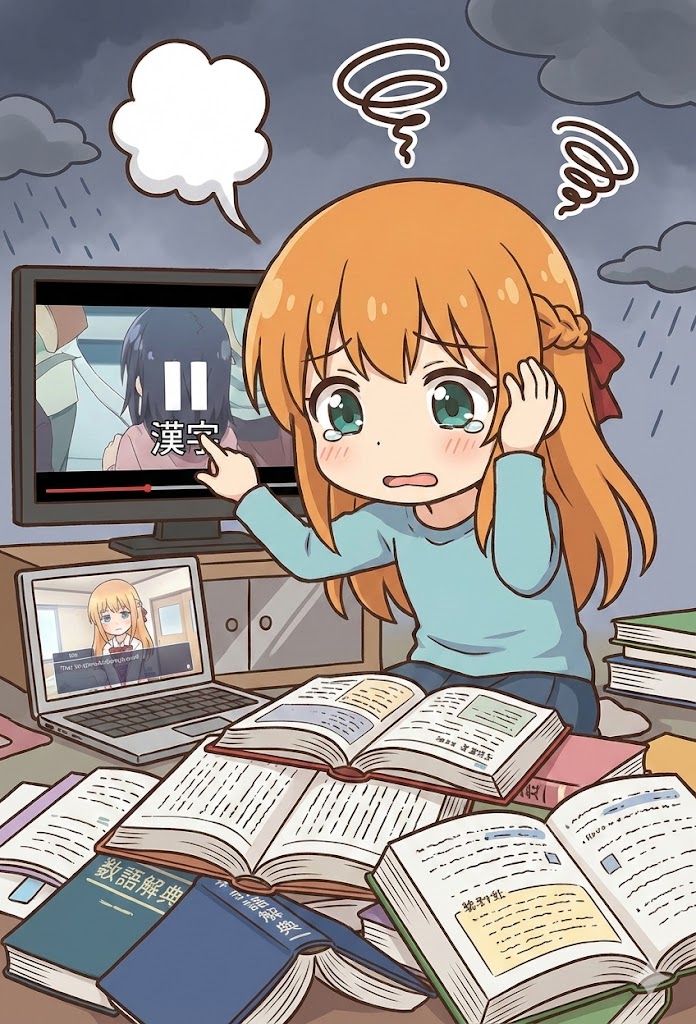
"I love anime and gaming, and I want to learn Japanese so I can enjoy them even more!" Countless fans around the world start their Japanese learning journey with this exact passion. However, so many of them eventually hit a massive brick wall and give up, feeling defeated:
"Japanese is just too hard. I can't do this..."
"I studied so hard, but I still can't understand a single thing they're saying in my favorite anime."
Why does this happen? Why does genuine effort so often lead to this frustrating trap?
In this article, I want to break down the definitive differences between the Japanese taught in traditional textbooks and the real-world Japanese used in anime and games.
1. Textbook Japanese: Why It Leads to Burnout
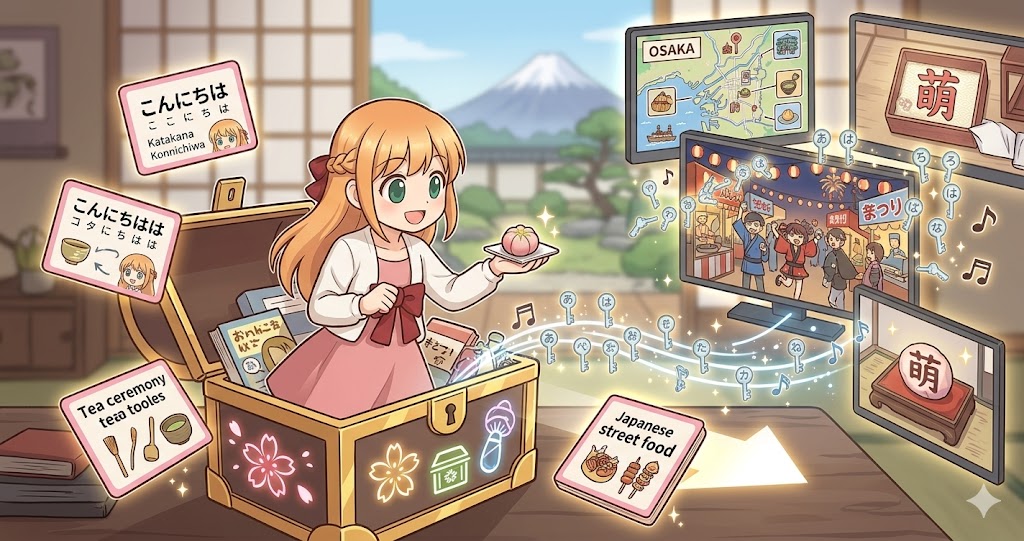
First, let’s look at the core characteristics of standard textbook Japanese and why I believe it often fails anime and gaming enthusiasts.
- A "logical" curriculum that breeds boredom
- Unnatural phrases detached from real-life conversations
- The overwhelming wall of Kanji and grammar rigidness
What is "Textbook Japanese"?
When you open a standard textbook, you are greeted with flawless, grammatically pristine sentences like "Watashi wa Taro desu" (I am Taro) or "Kirei desu ne" (It’s beautiful, isn’t it?). These are essential building blocks, meticulously designed to help beginners progress step-by-step.
The downside, however, is that textbooks are packed with overly explanatory, robotic phrases that native speakers rarely use in real life—such as "Kyou wa totemo atsui desu kara, mizu wo takusan nomimasu" (Because it is very hot today, I will drink a lot of water).
While this structured method is "logical" for learning grammar rules, it takes an incredibly long time before you can understand actual, live conversations, causing many students to lose their motivation.
Sterile and Boring Topics
Textbooks are built to help you pass standardized tests like the JLPT (Japanese Language Proficiency Test) or navigate formal business settings. Consequently, they focus on safe, repetitive topics:
"What will you eat today?"
"What will you study this weekend?"
While useful, these mundane conversations are almost non-existent in the high-stakes, fantasy, and sci-fi worlds of anime and games.
The Kanji and Grammar Grind
Endless rows of Kanji characters and complex grammatical structures are the ultimate gatekeepers of the Japanese language. Rote memorization through a textbook turns language learning into a tedious chore rather than an exciting hobby.
2. Anime & Game Japanese: The Real-World Dynamic
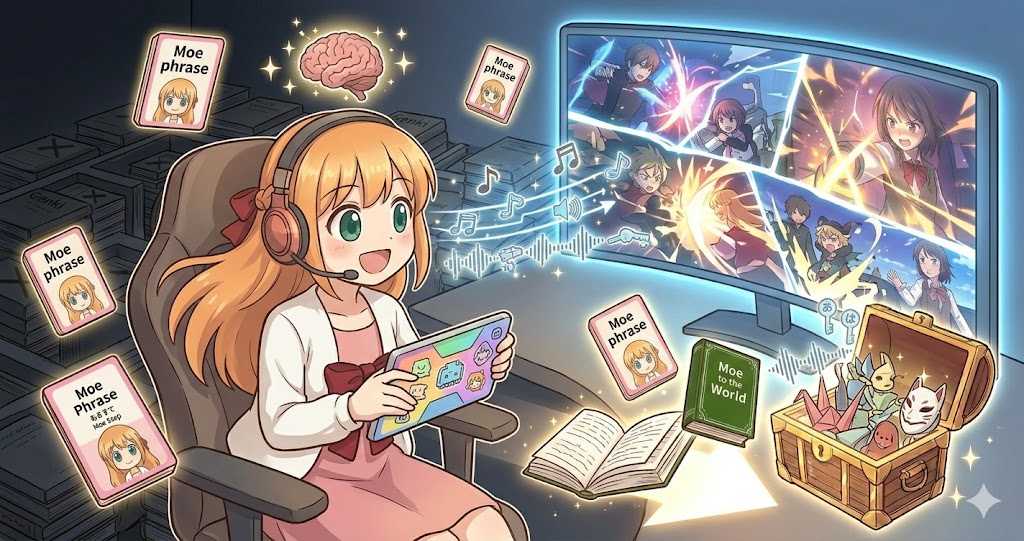
In stark contrast, the Japanese you encounter in anime and games follows a completely different set of rules:
- 90%+ Dialogue: It’s all about speech styles, sentence endings, and slang
- An intense focus on emotional and psychological expression
- Prioritizing listening and reading over writing kanji
Dialogue-Driven and Packed with Personality
The most defining trait of anime and games is that they are entirely driven by dialogue.
Rather than reading dry descriptions, you are constantly listening to characters interact, question each other, and express intense raw emotions.
Furthermore, anime characters speak with distinct "anime-only" sentence endings (known as yakuwarigo or role language), specific speech patterns that reflect their personalities or relationships, and heavy doses of slang.
Textbooks completely ignore these elements. This is why you can ace the JLPT and still feel completely lost when watching a show without subtitles.
The good news?
Once you grasp these specific anime vocabulary words, unique sentence endings, and common slang, the voice acting and visual cues do the rest of the heavy lifting.
You don't need perfect grammar to intuitively understand the context.
It’s All About "Feelings" and "Philosophy"
Anime and games are built on profound character dynamics and narrative arcs, meaning the language is heavily saturated with emotional vocabulary.
Especially in visual novels, you will encounter long, introspective monologues dealing with a protagonist's deepest thoughts and philosophical outlooks.
While traditional textbooks force you to learn a shallow pool of words across every broad topic imaginable, mastering anime Japanese requires focusing heavily on words related to emotions, beliefs, and inner resolve. From my experience, targeting this specific vocabulary is the fastest shortcut to boosting your comprehension from a shaky 60% to a confident 80%.
Input Over Output: You Don't Need to Write Kanji
When you are watching a show or playing an RPG, you aren't writing Kanji or giving speeches.
What you actually need is strong "Listening" comprehension and, for gaming,
"Reading" stamina. Backed by audio tracks and visual context, you don't even need to decode every single syllable to follow the story perfectly.
Summary: Textbook Learning vs. Anime Learning
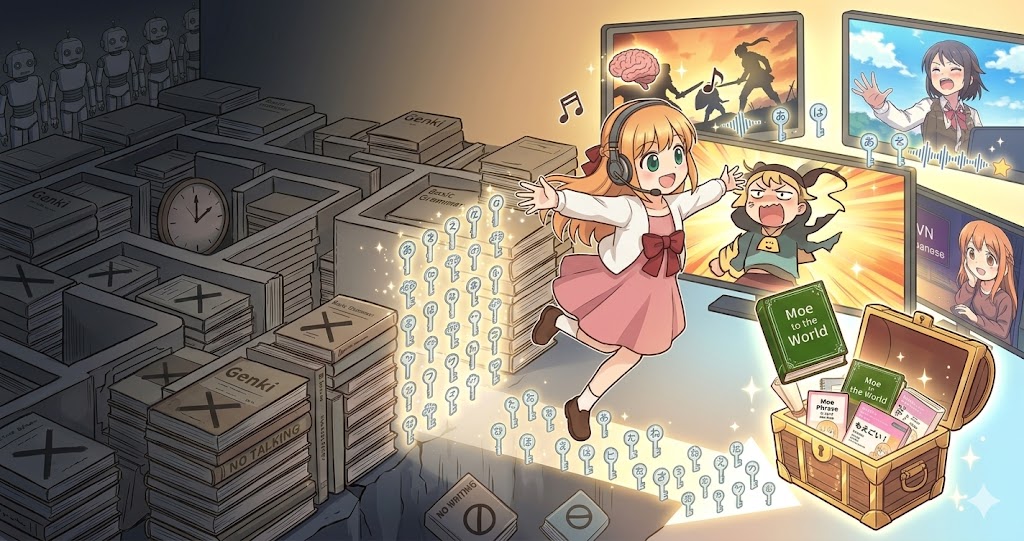
Here is a quick breakdown of how these two paths differ:
| Focus Area | Textbook Japanese (JLPT, etc.) | Anime & Game Japanese |
| Core Skills | Balancing all 4 skills (Reading, Writing, Speaking, Listening) | Prioritizing Listening and Reading (Games) |
| Learning Core | Strict grammar rules and Kanji stroke orders | High-frequency vocabulary & phrases used in media |
| Vocabulary Type | Daily chores, business, and general society | Words expressing emotions, thoughts, and core beliefs |
| Tone & Style | Polite, standardized Japanese (Teineigo) | Character-specific speech styles, endings, and slang |
| Comprehension | Understanding 100% perfectly from text alone | Grasping context through voice, tone, and visuals (Perfection not required) |
As you can see, when your goals are completely different, your approach should be too.
If your primary motivation for learning Japanese is to immerse yourself in anime and gaming, traditional textbooks are an inefficient and often discouraging path.
You need an approach tailored to the media you love.
As the creator of MoeLab!,
I bridge this exact gap.
I personally design and offer vibrant, practical learning materials focused entirely on the real Japanese used in anime and games.
Why not kickstart your specialized Japanese journey with me today? Packages start at just $2.90—let's dive into the world you love, the right way!